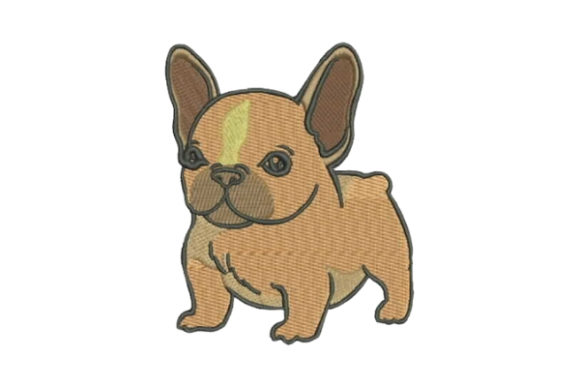
Small Puppy: A Designer’s Real-World Embroidery Review
First Impressions: Sweet, Simple, and Surprisingly Versatile
When I opened Small Puppy for the first time, I wasn’t expecting complexity—and that’s exactly what makes it work. It’s not a hyper-detailed portrait or a stylized cartoon; it’s a gentle, rounded silhouette with soft curves, minimal facial features, and just enough personality to read as “puppy” at a glance. The shape feels balanced in the hoop—no awkward limbs stretching beyond safe stitch zones, no tiny ears lost in fill stitch noise. It reads as friendly, approachable, and quietly confident—not cloying, not generic. That’s rare in dog-themed embroidery files, where cuteness often tips into visual clutter.
A Real Project Test: Custom Baby Towels for a Local Boutique
Last month, I used Small Puppy on a set of organic cotton kitchen towels destined for a boutique’s newborn gift bundle. We stitched it centered on the lower corner—just above the hem—using pale oat thread on ivory fabric. The result? Instant warmth. Customers didn’t just see “embroidered towel”—they saw *care*, *intention*, and a quiet nod to new life. One mom texted the shop owner saying, “It made me tear up. So simple—but so *right*.” That’s the power of restraint done well. Small Puppy doesn’t shout. It invites.
Where It Shines (and Where It Needs Thought)
Small Puppy performs beautifully across several real-world applications:
- Custom apparel: On midweight cotton sweatshirts and structured tote bags, its clean lines hold up without distortion—even after multiple washes.
- Baby embroidery: Its scale and simplicity make it ideal for onesies, burp cloths, and swaddle blankets. No dense satin stitch eyes to irritate sensitive skin.
- Embroidered patch: When stitched on twill and heat-applied, it reads clearly from three feet away—no fuzzy edges or collapsed details.
- Holiday embroidery: Paired with a tiny red bow or stitched in metallic gold thread, it softens seasonal collections without feeling out of place.
- Etsy seller & small shop product: It scales gracefully across digital product previews and printable mockups—looks cohesive whether shown on a pillow cover, apron, or tea towel listing.
But—and this matters—it’s not universally forgiving. On ultra-thin rayon or heavily textured linen, I recommend testing stitch density first. Dense fill areas can pucker if stabilizer isn’t matched precisely to fabric weight. And while it works on dark fabric, avoid light thread colors unless you’re willing to add underlay or double-stitch for opacity. Curved surfaces like caps require careful hooping and possibly repositioning—its symmetry helps, but don’t assume it auto-adjusts.
Design Integrity in Action
What separates Small Puppy from forgettable clipart is how thoughtfully it handles transitions between stitch types. There’s no muddy edge where satin stitch meets fill stitch—just a subtle, intentional break that implies dimension without over-engineering. That means less post-stitch cleanup (no snipping stray threads), cleaner trimming for patches, and more consistent results across machines. For a craft business owner stitching 50+ units a week, that reliability saves time and builds trust. Your customers don’t know about underlay settings—but they *feel* the difference when every puppy looks crisp, not tired.
Practical Notes Every Designer Should Check Before Stitching
- Test on scrap fabric first—especially if using textured, stretchy, or dark materials. See how thread color contrast holds up in natural light.
- Review stitch density in your embroidery software. If it’s heavy in the body area, consider reducing density by 5–8% for lightweight fabrics.
- Confirm hoop size compatibility. Does it fit comfortably in your most-used hoop—or will you need to resize? Resizing too small risks losing definition in the muzzle and ear curves.
- Inspect small details at 200% zoom: Are stitch angles clean? Do corners land crisply? Is there unnecessary travel stitching?
- Try black-and-white mockups before finalizing listings. Some charm lives in tonal subtlety—not just color.
- Match stabilizer to end use. Tear-away for stable cottons; cut-away for knits or items needing durability (like baby clothes).
- Verify licensing terms before selling finished products or bundling Small Puppy into digital embroidery kits. Not all dog-themed designs permit commercial resale.
Why This Fits Real Creative Businesses
If you’re an Etsy seller curating personalized gifts, Small Puppy adds emotional resonance without demanding technical heroics. It pairs effortlessly with monograms, birth dates, or minimalist fonts—never competing, always complementing. For apparel decorators building a signature style, it’s a reliable anchor design: recognizable at a glance, adaptable across seasons, and easy to brand with consistent thread palettes.
And for handmade product makers who value authenticity? It avoids the “digital overload” trap. No excessive layers, no forced realism—just honest, hand-guided charm translated into machine embroidery design. That honesty translates directly to customer perception: this feels made *for* people, not just *by* machines.
The Final Stitch
Small Puppy won’t replace your go-to floral motif or bold typography—but it fills a quiet, essential niche: the design that says “thoughtful,” “gentle,” and “made with care” in under 1,000 stitches. It’s the kind of embroidery file that earns repeat orders, gets tagged in Instagram stories, and shows up in holiday wish lists without explanation. In a market flooded with busy, loud, or overly literal dog embroidery, Small Puppy stands out by knowing exactly when to stop.
Use it where softness matters. Where simplicity carries weight. Where a single stitch tells a story—and lets the person holding the finished product feel seen.