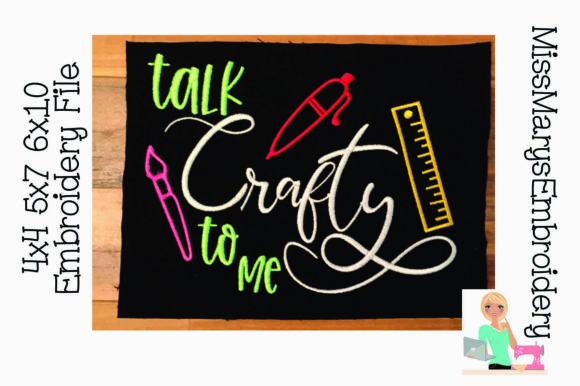
Talk Crafty to Me
A Practical Review for Small Business Merchandise & Branded Patches
As an embroidery designer who’s digitized and stitched thousands of logos for cafés, boutiques, bakeries, florists, pet brands, and handmade studios, I approach every new machine embroidery design with two questions: “Does it translate well into thread?” and “Will it strengthen a small business’s brand identity?” When I first saw Talk Crafty to Me, my instinct was to pause—not because it’s flashy or complex, but because its tone is so intentionally warm and conversational. That’s rare in Sewing Crafts and Embroidery files meant for commercial use. Let’s break down how this design holds up not just as decoration, but as functional, scalable brand equity.
First Impression: Friendly, Handmade, and Confidently Approachable
Talk Crafty to Me reads like a friendly wink—not loud, not stiff, but full of personality. It leans into the handmade product aesthetic without feeling rustic or dated. There’s no forced whimsy or over-the-top script; instead, it strikes a balance between modern readability and craft-driven charm. For a small business owner launching custom apparel or branded patches, that tone matters. It signals authenticity, invites engagement, and fits seamlessly across diverse niches—from a ceramic studio’s apron embroidery to a local florist’s tote bag design.
Real-World Performance Across Business Applications
I tested Talk Crafty to Me across several high-demand small business merch scenarios:
- Embroidered patches: Works beautifully at 2.5"–3.5" height—clean letterforms hold shape, spacing stays legible, and the phrase flows naturally in satin-stitch borders. Ideal for sew-on or iron-on patches on jackets, shop aprons, or gift packaging.
- Staff uniforms & caps: At 2" wide on a cap front, it reads clearly without crowding. The lowercase “t” and “y” avoid awkward stretching on curved surfaces when digitized with proper underlay and pull compensation.
- Tote bags & work shirts: Scales well to 4"–5" width on cotton canvas or twill. The rhythm of the phrase gives visual breathing room—no dense stitch clusters that risk puckering on looser weaves.
- Product packaging accents & boutique merchandise: As a subtle chest logo on reusable bags or as a sleeve detail on staff tees, Talk Crafty to Me adds warmth without overwhelming the product. It complements hand-stamped tags or printed labels rather than competing with them.
- Etsy branding & digital embroidery file buyers: Its versatility makes it a smart addition to a shop’s design assets—especially paired with coordinating icons (scissors, thread spools, yarn balls) for printable mockups or cohesive collections.
Where to Use Talk Crafty to Me Thoughtfully
Even strong designs need context-aware execution. Here’s where attention pays off:
- Small patch sizes (<2"): Test the digital embroidery file at 1.75" first. Some letters—especially the “c” and “r” in “Crafty”—can lose definition if the original digitization skimps on underlay or edge walk.
- Dark uniforms or textured fabric: Thread color contrast is critical. Navy or charcoal twill demands rich, saturated thread—avoid pastels unless backed by white underlay. Always test stabilizer choice: medium-weight cutaway works best for durability across frequent washing.
- Cap embroidery: Confirm hoop size compatibility before stitching. If the design exceeds 2.25" in height, consider simplifying descenders or adjusting kerning to fit standard cap hoops.
- High stitch density areas: While Talk Crafty to Me avoids excessive fill, check for tight loops or overlapping satin columns—these can cause thread breaks on long production runs. A quick stitch simulation helps spot trouble zones.
How Talk Crafty to Me Builds Brand Trust & Recognition
For small businesses, consistency is credibility. Talk Crafty to Me isn’t just a phrase—it’s a micro-promise. When stitched on a barista’s apron, it tells customers, “We’re proud of what we make.” On a bakery’s reusable bag, it reinforces care and craft—not mass production. That emotional resonance lifts perceived value, encourages repeat engagement, and supports visual consistency across touchpoints. Unlike generic slogans, it feels owned, intentional, and human. That builds trust faster than any stock vector ever could.
Essential Embroidery Designer Notes Before Production
If you’re preparing Talk Crafty to Me for commercial embroidery or client delivery, here’s your checklist:
- Start with a black-and-white test stitch—this reveals spacing issues, thin strokes, and unintended gaps invisible on screen.
- Verify legibility at your smallest intended size (e.g., 1.5" for pocket logos or mini patches).
- Review thread color options against your base fabric—contrast impacts both durability and brand clarity.
- Inspect letter spacing and kerning. Tight tracking may blur at small scale; generous spacing improves readability on curved surfaces like caps.
- Confirm hoop size requirements and match stabilizer weight to fabric texture and end-use (e.g., tear-away for tote bags, cutaway for staff uniforms).
- Always stitch a physical sample on the actual garment or patch material—not just a test swatch.
- Create a printable mockup for client approval. Seeing Talk Crafty to Me on a real apron or cap builds confidence before bulk production.
- Compare it beside your other design assets—does it harmonize with your logo, icon set, and overall visual language?
- Double-check commercial licensing terms. Since this is described as a freebie, confirm whether redistribution, resale, or inclusion in digital embroidery bundles is permitted before using it in client projects or Etsy listings.
Ultimately, Talk Crafty to Me succeeds because it understands its audience: small business owners who don’t just sell products—they share passion, process, and personality. When translated thoughtfully into thread, it becomes more than a machine embroidery design. It becomes a quiet handshake with every customer who sees it stitched on an apron, embroidered on a cap, or stitched onto a handmade tote bag. That’s the power of intentional, business-savvy Embroidery.