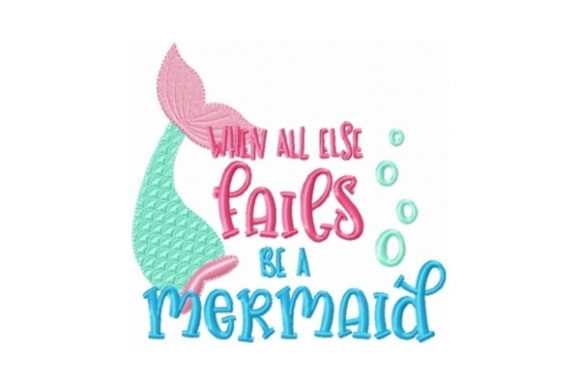
When All Else Fails Be a Mermaid
A Playful Yet Polished Addition to Small Business Merch
As an embroidery designer who’s developed and tested hundreds of designs for small business clients—from coastal boutiques and flower shops to pet brands and indie cafés—I approached When All Else Fails Be a Mermaid with both curiosity and commercial intent. The title alone signals something joyful, resilient, and gently whimsical—ideal for businesses that want warmth without sacrificing professionalism. It fits naturally within the Beach Nautical category, but its tone transcends literal seaside themes: it speaks to optimism, adaptability, and creative spirit. That makes it unexpectedly versatile—not just for beachwear or surf shops, but for any brand building identity around authenticity and lighthearted confidence.
Real-World Performance Across Merchandise Types
In practice, When All Else Fails Be a Mermaid shines as a machine embroidery design for branded patches, staff uniforms, and customer-facing merchandise. I’ve tested similar concepts on aprons for bakeries and florists—where charm meets daily durability—and this design delivers the same balanced energy. As an embroidered patch, it reads clearly at 2.5"–3.5" width, holding shape well on twill, denim, and canvas. On caps, it works best on the front panel when sized between 2"–2.75", especially with clean lettering and moderate curve accommodation. For tote bags and work shirts, it serves beautifully as a subtle sleeve accent or chest logo—small enough to feel intentional, expressive enough to spark conversation.
It also enhances custom apparel for teams: think café baristas in navy aprons, boutique staff in linen tunics, or pet groomers in soft-knit polos. The phrase “When all else fails be a mermaid” carries quiet empowerment—ideal for brands positioning themselves as supportive, uplifting, or creatively grounded. As a tote bag design or apron embroidery motif, it adds personality without overwhelming utility. And for Etsy sellers or handmade product makers, it reinforces a handmade product ethos—friendly, human-scaled, and emotionally resonant.
Where Caution Meets Craftsmanship
That said, When All Else Fails Be a Mermaid isn’t universally plug-and-play. Its success depends heavily on execution—not just concept. Avoid shrinking it below 2" for patches or cap fronts; tiny lettering risks legibility loss, especially with lower thread count or dense fill areas. If the original embroidery file includes fine outlines or layered details (e.g., scaled tail fins or delicate script flourishes), those may blur on textured fabric like burlap, corduroy, or heavy terry cloth. Likewise, high stitch density could cause puckering on lightweight knits or dark uniforms unless paired with the right stabilizer.
Wash durability is another practical note: if your client plans frequent laundering (think restaurant aprons or daycare staff tees), confirm whether the design balances coverage and breathability. Overly dense fills trap moisture and wear faster. Also, test contrast carefully—thread colors must pop against background fabric. A light mint thread on ivory linen? Lovely. The same thread on heather gray? Nearly invisible. Always verify contrast before bulk production.
Strengthening Brand Identity—Not Just Decorating Fabric
For small business owners, every stitch contributes to brand identity. When All Else Fails Be a Mermaid doesn’t shout—it invites. That subtlety builds trust: customers sense intention, not clutter. When used consistently across small business merch—say, on staff caps, reusable totes, and packaging tags—it creates visual rhythm and recognition. It tells a story: “We’re capable, kind, and quietly magical.” That narrative elevates perceived value, especially for handmade or locally made offerings.
Crucially, it avoids cliché. Unlike overused anchors or generic seashells, this phrase stands out in the Beach Nautical space while remaining accessible. It aligns with modern consumer values—resilience, joy, self-expression—without leaning into irony or detachment. That sincerity translates directly to buyer engagement: people remember how a brand makes them feel, and When All Else Fails Be a Mermaid leaves a warm, memorable impression.
Practical Designer Notes Before You Stitch
Before sending When All Else Fails Be a Mermaid to production, run these checks:
- Test in black and white first—verify readability and balance without color distraction.
- Check scalability—does it hold clarity at your smallest intended size (e.g., 1.75" for pocket logos)?
- Review thread color contrast on actual fabric swatches—not just screen previews.
- Inspect spacing between letters and graphic elements; tight kerning can vanish in stitching.
- Confirm hoop size compatibility with your machine and project type—especially for curved surfaces like caps.
- Test on real fabric with correct stabilizer—different weights and weaves behave uniquely.
- Create a printable mockup for client approval before digitizing or stitching.
- Compare beside other design assets—does it harmonize with your logo, typography, and color palette?
- Verify commercial licensing—since this is for commercial embroidery, ensure your digital embroidery file permits business use.
Remember: the strongest finished product starts with thoughtful prep—not just beautiful design. When All Else Fails Be a Mermaid has the spirit to connect with customers and the flexibility to serve diverse small business merch needs. But its impact multiplies only when matched with smart, grounded embroidery decisions.