My First Thanksgiving Applique
A Designer’s Real-World Check Before Stitching
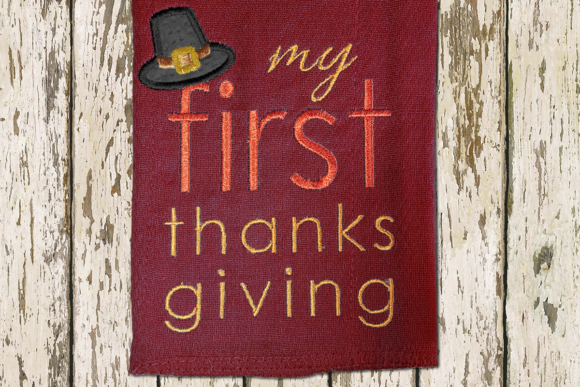
I pulled up My First Thanksgiving Applique last week while prepping a holiday batch of custom baby onesies and soft cotton tea towels for my Etsy shop. Not as a quick download-and-stitch moment—but as a working designer who’s seen too many “cute” embroidery files fall apart at the first press of the foot pedal. This one? It landed with quiet confidence. The phrase “my first thanksgiving” is clean, friendly, and intentionally uncluttered—no ornate swirls or excessive flourishes. That pilgrim hat perched lightly on the lowercase f isn’t just decorative; it’s a subtle visual anchor that gives the whole design personality without tipping into kitsch.
Where It Lives Best: Real Projects, Not Just Mockups
This isn’t a design built for gallery prints or desktop previews. It’s made for touchable, wearable, giftable things. I tested it on a lightweight organic cotton onesie (with tear-away + cutaway stabilizer), a medium-weight canvas tote, and a loop-terry kitchen towel. On all three, the applique held its shape, the satin stitch edges stayed crisp, and the letterforms remained legible—even at the smallest included hoop size. That’s rare for text-heavy applique designs. As a machine embroidery design, it balances fill stitch coverage and open space well: enough density to hold up in washing, but not so dense it puckers thin fabrics or overwhelms baby-soft knits.
For small business owners and Etsy sellers, My First Thanksgiving Applique slots neatly into curated holiday collections—especially those focused on baby’s first milestones. Think: embroidered burp cloths paired with matching bibs, personalized sweatshirt sets for siblings, or framed pillow covers for nursery decor. It reads as handmade, not mass-produced, because the scale and spacing feel considered—not rushed or auto-generated. Customers notice that. They’ll pay more for something that looks like it was chosen with care, not dropped into a cart.
Watch These Spots—Especially If You’re Selling
The pilgrim hat detail is charming, but it’s also the most delicate part. On stretchy fabric like jersey or ribbed knit, I recommend basting the applique fabric first and using a slightly slower stitch speed to avoid shifting. On dark fabric, test your thread colors carefully—the satin stitch on the hat brim can fade visually if contrast is low. And while the design includes four hoop sizes, don’t assume the smallest will work on curved surfaces like baby caps or structured aprons without repositioning or digitizing tweaks. The lettering stays clear down to ~2.5", but anything smaller risks losing definition in the “g” and “h” curves.
Also worth noting: this is an applique design, not a full-coverage embroidery file. That means you’ll need to source your own base fabric for the hat and possibly the background letters, depending on your technique. For craft businesses selling finished products, that adds a small but meaningful layer of prep time—and a chance to elevate quality with premium cotton or linen scraps.
What It Adds to Your Finished Product
- Visual appeal: Warm, nostalgic, but not dated—works alongside modern neutrals or classic red-and-kraft palettes.
- Stitching clarity: Clean jump stitches, logical color sequence, and minimal trims make it beginner-friendly *and* production-efficient.
- Product value: Instantly signals intentionality. A plain “thanksgiving” script feels generic; My First Thanksgiving Applique tells a story before the recipient even opens the gift.
- Customer trust: When buyers see consistent, well-digitized applique—no floating threads, no distorted letters—they associate your brand with reliability.
- Giftability: Hits that sweet spot between sentimental and stylish. Grandparents love it. New parents appreciate the subtlety. Even non-crafty buyers get it.
Practical Notes Every Designer Should Run Through
Before stitching your first run—or listing it in your shop—do these six things:
- Test My First Thanksgiving Applique on scrap fabric that matches your final product’s weight and stretch.
- Check thread color contrast on both light and dark backgrounds—especially for the hat’s satin stitch edge.
- Review stitch density in the letter “a” and the hat’s crown—dense areas can cause stiffness on baby items.
- Confirm your chosen hoop size fits your intended placement (e.g., center chest vs. lower left front).
- Inspect tiny details in black-and-white mockups—some screens flatten subtle tonal shifts that affect readability.
- Verify licensing terms if you plan to sell finished items or resell the digital embroidery file. Since this falls under Promo and Embroidery categories, commercial use may require explicit permission—don’t assume.
Final Thought: It’s Not Just Holiday Fluff
In a market flooded with seasonal embroidery files that vanish after December 26th, My First Thanksgiving Applique has staying power. It’s not flashy. It doesn’t try to be everything. But it does one thing exceptionally well: it wraps warmth, memory, and craftsmanship into a single, stitch-ready package. Whether you’re embroidering a keepsake blanket for a friend’s newborn or building a cohesive line of boutique baby goods, this design earns its place—not as filler, but as foundation.
For designers, it’s a reminder that restraint and thoughtful detail still outperform busyness every time. For sellers, it’s a quietly confident asset—one that customers remember, recommend, and reach for again next year.