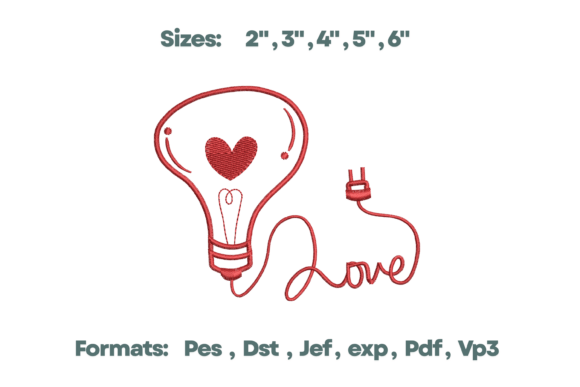
Light Bulb Love Connection Embroidery
A Practical Review for Small Business Merch & Branded Patches
As an embroidery designer who’s digitized and stitched thousands of commercial projects—from café aprons to boutique tote bags—I approached the Light Bulb Love Connection Embroidery with both curiosity and critical intent. This isn’t just another Valentine’s Day motif—it’s a potential brand asset. The title alone signals warmth, ingenuity, and emotional resonance—ideal for small businesses that want to communicate care, creativity, and connection without cliché.
First Impression: Friendly, Modern, and Purposefully Clear
The description—“a bright idea pattern uses clean line work and a vibrant red heart to symbolize the energy and lig”—immediately tells me this design prioritizes readability and symbolic clarity over ornate detail. That’s excellent news for small business merch. It reads as modern, approachable, and confidently minimal—not rustic or vintage, not overly technical or sterile. For a florist adding charm to staff aprons, a creative studio branding tote bags for client gifts, or a pet brand stitching heart-led playfulness onto bandanas, Light Bulb Love Connection Embroidery lands with sincerity and visual ease.
Real-World Performance Across Business Applications
In my experience, the strongest machine embroidery designs earn their keep across multiple touchpoints—and this one does. As an embroidered patch, its clean silhouette holds up beautifully when heat-applied or sewn onto denim jackets, canvas totes, or uniform sleeves. On caps, it works well centered on the front panel if scaled thoughtfully (more on sizing below). For apron embroidery, it adds personality without overwhelming function—especially when placed just above the pocket or subtly on the strap.
For custom apparel like staff tees or branded work shirts, the design’s balanced proportions prevent distortion during wear and laundering. Its heart-and-bulb composition is instantly legible at 2.5–3 inches wide—ideal for chest logos or sleeve accents. As a tote bag design, it conveys intentionality: not just “I bought this,” but “I support a business that thinks with heart.” And for Etsy sellers or handmade brands, pairing this digital embroidery file with a printable mockup helps customers visualize value before purchase—boosting conversion and reducing returns.
Where to Use Light Bulb Love Connection Embroidery With Care
No design is universally frictionless—and knowing the limits is where professional execution begins. Because the description highlights “clean line work” and a “vibrant red heart,” I recommend caution in these scenarios:
- Small patch sizes under 1.75 inches: Fine outlines may blur or stitch poorly on dense fabrics. Always test at final size.
- Cap fronts with steep curvature: The bulb’s top curve and heart’s lower point need stabilizer support and possibly slight digitizing adjustment for smooth wrap.
- Dark uniforms or textured fabric: A vibrant red thread must contrast strongly—verify thread color against base fabric in natural light, not just on screen.
- Frequent-wash items (e.g., café aprons): Confirm stitch density isn’t so high it compromises flexibility or durability over time.
Also note: If your version includes implied lettering (e.g., “Love Connection” in fine script), treat that area as high-risk for legibility loss—especially on curved surfaces or low-thread-count cotton.
How It Strengthens Brand Identity & Customer Trust
Small businesses thrive on authenticity and recognition—and Light Bulb Love Connection Embroidery supports both. Its dual symbolism (innovation + affection) subtly reinforces values many local brands embody: thoughtful service, creative problem-solving, and human-centered care. When stitched consistently across staff uniforms, product packaging accents, and customer gift totes, it builds visual consistency without demanding a full logo overhaul.
More importantly, it elevates perceived value. A well-executed embroidered patch signals investment—in quality, craft, and customer experience. That perception translates directly to trust. Shoppers notice the difference between printed logos and precise, raised threadwork. For handmade product labels or craft fair merch, that tactile distinction makes your offering feel more intentional, more memorable.
Essential Embroidery Designer Notes Before Production
Before sending Light Bulb Love Connection Embroidery to production—or sharing it with clients—run through these practical checks:
- Test in black and white first: Strip away color to assess balance, spacing, and negative space. Does the bulb “breathe”? Does the heart anchor the composition?
- Verify small-size legibility: Resize to your smallest intended use (e.g., 1.5” patch) and zoom in. Are edges crisp? Is thread overlap minimal?
- Review thread color contrast: Red pops on light backgrounds—but on navy or charcoal, consider a slightly brighter or deeper red, or add a subtle white underlay.
- Inspect spacing between elements: Ensure the heart and bulb don’t merge visually at scale—especially on knit or stretchy fabric.
- Confirm hoop size compatibility: Does the design fit comfortably within your standard hoops? Avoid pushing borders too close to the edge.
- Test on real fabric: Run a sample on the exact material you’ll use—canvas, twill, denim, or poly-cotton blend—to assess tension, puckering, and stabilizer needs.
- Create a client-approved mockup: Use a realistic printable mockup to show how it looks on a cap, tote, or apron—not just as a flat file.
- Compare beside existing design assets: Does it complement your current logo, typography, or color palette—or compete with it?
- Confirm commercial licensing: Since this is intended for small business merch, commercial embroidery, and resale items, verify the license permits unlimited end-use before bulk production.
Remember: the strength of any machine embroidery design lies not in its prettiness alone—but in how reliably it stitches, scales, wears, and represents your brand across every finished product. Light Bulb Love Connection Embroidery delivers that reliability—if treated with the same thoughtful attention you give your coffee beans, your floral arrangements, or your handmade ceramics.