Key Fob Paw with Claws
First Impression: Bold, Playful, and Instantly Recognizable
As an embroidery designer who’s prepped over 200 craft fair booths—and shipped thousands of embroidered small shop products—I opened the Key Fob Paw with Claws file expecting charm, but what I got was presence. This isn’t a whisper—it’s a confident, slightly mischievous statement. The title alone telegraphs energy: “paw” suggests warmth and pet love; “claws” adds edge, personality, and just enough attitude to stand out in a sea of hearts, florals, and minimalist lines. It lands somewhere between modern rustic and friendly bold—think farmhouse apron meets indie pet boutique. No twee, no cliché, no overworked cuteness. Just clean, intentional character.
Where It Shines on Craft Fair & Handmade Products
This machine embroidery design thrives where personality meets utility—and that’s exactly what sells at markets and online. Here’s how it performs across your most profitable handmade items:
- Tote bag design: Perfect as a subtle side accent (3–4" wide) near the handle or centered low on the front panel. On natural canvas or oat linen, it reads as artisanal—not busy.
- Apron embroidery: Ideal above the pocket or stitched vertically along the strap. Its vertical orientation and strong silhouette hold up beautifully on curved waistbands and moving fabric.
- Tea towel embroidery: Works best in the lower corner or centered mid-panel. Avoid dense stitching near hems—this design’s clarity shines when given breathing room against open weave.
- Embroidered patch: A standout candidate. The claws and paw outline translate cleanly into a sew-on or iron-on format, especially at 2.5–3". Customers love collecting themed patches—and this one sparks conversation.
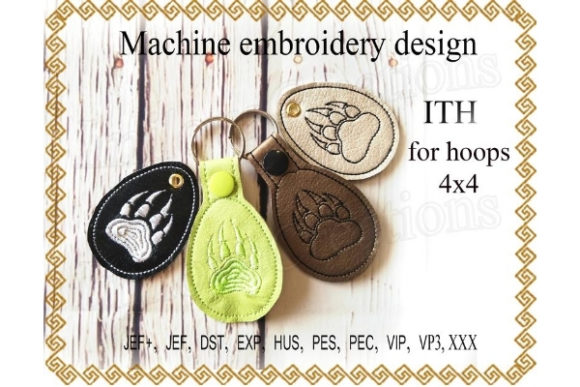
- Fabric pouches & key fobs (naturally): The namesake application. At 1.75–2.25", it balances detail and durability. Stitches stay crisp on cotton twill, cork-backed fabric, or medium-weight denim.
- Pillow covers & market bags: Use as a single focal point—not repeated. Its visual weight anchors the piece without overwhelming hand-stitched seams or textured yarns.
- Etsy seller listings: Photographs exceptionally well. The contrast between negative space and defined stitch lines creates strong thumbnail appeal. Pair with warm neutral backgrounds for instant cohesion.
Production Realities: What You Need to Know Before Hooping
This digital embroidery file is built for speed and consistency—but only if you honor its structure. As a working embroidery designer, I always ask: *Will this hold up under booth-speed production?* Here’s my assessment:
The Key Fob Paw with Claws avoids tiny lettering, micro-details, and overlapping satin columns—so it’s inherently batch-friendly. That said, watch for:
- Dense stitch areas: The claw tips and inner paw pads may pack tighter than average. Test on your target fabric + stabilizer combo—especially for tea towels or thick canvas. Too much density = puckering or thread breakage mid-run.
- Fabric texture matters: On highly textured towels or bouclé pouches, reduce size slightly (by ~10%) or simplify claw definition in your editing software. Clarity trumps literal accuracy at small scale.
- Dark fabric + light thread: This design relies on contrast. If stitching on navy, charcoal, or black, confirm your thread colors pop. A creamy off-white or soft gray works better than stark white for warmth.
- Curved surfaces (caps, pouches): While not designed for baseball caps, it adapts well to gently rounded items like bucket hats or drawstring bags—if hooped with light cutaway stabilizer and minimal stretch.
Why It Strengthens Your Booth & Brand
In a crowded craft fair aisle, customers scan in under three seconds. The Key Fob Paw with Claws delivers immediate recognition—no decoding required. It says “handmade with humor and care” before you say a word. Unlike generic florals or overused quotes, it invites connection: pet lovers pause, kids point, gift shoppers nod. That micro-moment of engagement lifts dwell time, increases sample handling, and boosts conversion.
For Etsy sellers and small shop owners, it reinforces brand consistency across product categories—same motif on a tote, a patch, and a tea towel signals intentionality. And because it’s versatile in scale and placement, it helps unify your visual story without feeling repetitive.
Designer Notes You Can’t Skip
Before cutting your first production run, do these six things:
- Test the embroidery file on scrap fabric matching your final product’s weight and texture.
- Check thread contrast—especially if selling to pet boutiques or rescue orgs where color symbolism matters.
- Review spacing: Does the design leave enough margin for seam allowances, folds, or binding?
- Confirm hoop size compatibility—some versions may require 4x4" or larger. Don’t assume.
- Inspect stitch density visually—not just in software. Zoom in. Look for potential nesting or thread stacking.
- Use the right stabilizer: medium-weight cutaway for stable fabrics (totes, aprons); tear-away for tea towels; fusible + tear-away hybrid for lightweight pouches.
And one non-negotiable: Create at least one real mockup—not just a printable mockup. Drape it on your actual tote, pin it to your apron sample, hang it from your booth key ring. See how light hits the claws. Feel the stitch height. Watch how it moves with fabric drape. That physical test reveals what screen previews never can.
Final Thought for Creative Entrepreneurs
The Key Fob Paw with Claws isn’t just another sewing crafts download—it’s a ready-made moment of delight. It bridges the gap between technical execution and emotional resonance. For craft fair sellers, it’s booth bait. For Etsy sellers, it’s listing gold. For embroidery business owners, it’s repeatable, scalable, and refreshingly distinct in a saturated market.
Just remember: even the strongest embroidery design depends on thoughtful execution. Check your commercial licensing before selling finished products. Compare fabric colors in natural light. And always—always—stitch a test before committing to 50 tea towels or 100 key fobs. Because in handmade, the difference between “cute” and “I need that *now*” lives in the details—and this design gives you every chance to get them right.