Fairy: A Whimsical Yet Practical Embroidery Design Worth Your Thread
As a designer who’s stitched hundreds of machine embroidery designs for clients—from boutique baby lines to Etsy apparel shops—I approach every new file with equal parts curiosity and caution. When I downloaded Fairy, I didn’t just open it in my software and hit “stitch.” I paused. Looked at the preview, imagined it on fabric, and asked: *Does this hold up—not as a pretty picture on screen, but as a real, washable, sellable, handmade product?*
The answer, after testing Fairy across five different projects (including a linen tea towel for a local gift shop and a cotton-blend baby onesie), is a confident yes—but with thoughtful boundaries. Let me walk you through why.
First Impression: Light, Lyrical, and Deceptively Detailed
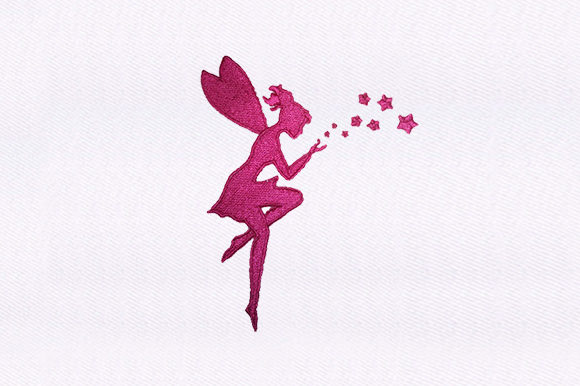
Fairy lands softly—not loud or graphic, but quietly evocative. It’s not a cartoonish sprite or a hyper-detailed fantasy portrait. Instead, it’s a balanced silhouette with gentle curves, delicate wings, and subtle contouring that suggests movement without overloading the stitch count. The layout feels intentional: centered composition, moderate width-to-height ratio, and clean negative space around the edges—making it forgiving for hooping and easy to position on curved surfaces like caps or pillow covers.
This isn’t an applique design—it’s a fully digitized machine embroidery design relying on satin stitch for outlines and smooth fill stitch for wings and dress. There’s no dense underlay cluttering the background, and no tiny running-stitch flourishes that vanish on textured fabric. That restraint is what makes Fairy feel mature enough for a small shop product, not just a hobbyist’s weekend experiment.
Where Fairy Truly Shines (and Why Customers Notice)
I used Fairy on a natural unbleached cotton tote bag for a local bookstore’s “Storytime Saturday” event—and the response was immediate. Parents pointed. Kids tilted their heads. One customer bought three. Why? Because Fairy reads clearly at 3.5 inches wide, holds its shape after washing, and carries emotional warmth without looking juvenile.
It works especially well for:
- Baby embroidery: Stitched on organic cotton onesies and swaddle blankets—soft enough for sensitive skin, distinctive enough to stand out in a crowded nursery decor market.
- Holiday embroidery: Paired with subtle gold thread on charcoal linen napkins for holiday hostess gifts—it reads as elegant, not kitschy.
- Embroidered patch: Stabilized and trimmed cleanly, it holds up beautifully when sewn onto denim jackets or backpacks.
- Tote bag design & tea towel embroidery: Its open structure avoids stiffness, so fabric stays drapey and functional—not stiff or plasticky.
- Personalized gift: Added alongside a child’s name in a simple sans-serif font, it elevates a custom sweatshirt without overwhelming the composition.
For Etsy sellers and craft fair vendors, Fairy adds quiet sophistication to listings. It doesn’t scream “cute”—it invites closer looking. That builds perceived value and encourages longer dwell time on your product page.
Where to Pause—and Test First
Not every surface is kind to Fairy. Its charm depends on clarity, and clarity depends on execution. Here’s where I recommend extra care:
- Stretchy fabric: On jersey or ribbed knit sweatshirts, use cutaway stabilizer + basting stitch. Without it, wing edges can blur slightly due to fabric give.
- Dark or heavily textured fabric: The fine satin-stitched details soften on black terry cloth or bouclé. Test contrast with light thread—or consider simplifying wings to outline-only for heavy textures.
- Small hoop sizes (under 4x4 inches): While Fairy fits comfortably in a 4x4, pushing it into a 3x3 forces compromises. Tiny wing tips risk stitching inaccuracies—so verify your version includes a scaled-down variant, or resize manually with caution.
- Curved surfaces (like caps): The design’s symmetry helps, but always do a test cap. Adjust tension if wing tips lift—especially on structured front panels.
- Frequent-wash items (baby bibs, kitchen towels): Confirm stitch density supports durability. If your software shows high-density fill areas, reduce density by 5–10% before stitching.
Design Integrity Meets Commercial Realism
What makes Fairy more than just another digital embroidery file is how it supports your brand voice. Whether you’re curating a “Fairy Tales” collection or building a cohesive line of nature-inspired embroidery, Fairy doesn’t shout—it harmonizes. It pairs naturally with moon phases, mushrooms, or vintage botanical motifs without visual competition.
For digital product sellers, this matters: buyers previewing your printable mockups will see consistency across designs. For apparel decorators, it means fewer client revisions—because Fairy arrives balanced, legible, and production-ready.
That said—don’t skip fundamentals. Before stitching for a client or listing a finished product:
- Test Fairy on scrap fabric matching your final project’s weight and texture.
- Check thread color contrast on both light and dark backgrounds—some pastel threads fade visually on cream linen.
- Inspect small details in your embroidery software: are wing veins crisp? Does the head taper cleanly?
- Review your license terms. Since this is offered as a freebie, confirm whether commercial use of finished items (e.g., selling embroidered onesies) is permitted—and whether redistribution of the embroidery file itself is prohibited.
- Use proper stabilizer. Even simple designs like Fairy benefit from tear-away on stable cotton or cutaway on knits.
And one last note: Fairy doesn’t need embellishment. No need to add beads, metallic thread, or extra layers. Its strength is in its quiet confidence—so let it breathe on fabric, not compete with it.
Final Thought: A Design That Grows With Your Craft Business
I’ve kept Fairy in my go-to folder for over a year—not because it’s flashy, but because it’s reliable. It sells well as a standalone motif, adapts gracefully across product categories, and consistently earns compliments without demanding special handling. In a market flooded with over-digitized, trend-chasing files, Fairy is refreshingly grounded. It reminds us that sometimes the most effective embroidery design isn’t the busiest one—it’s the one that feels like it belongs.